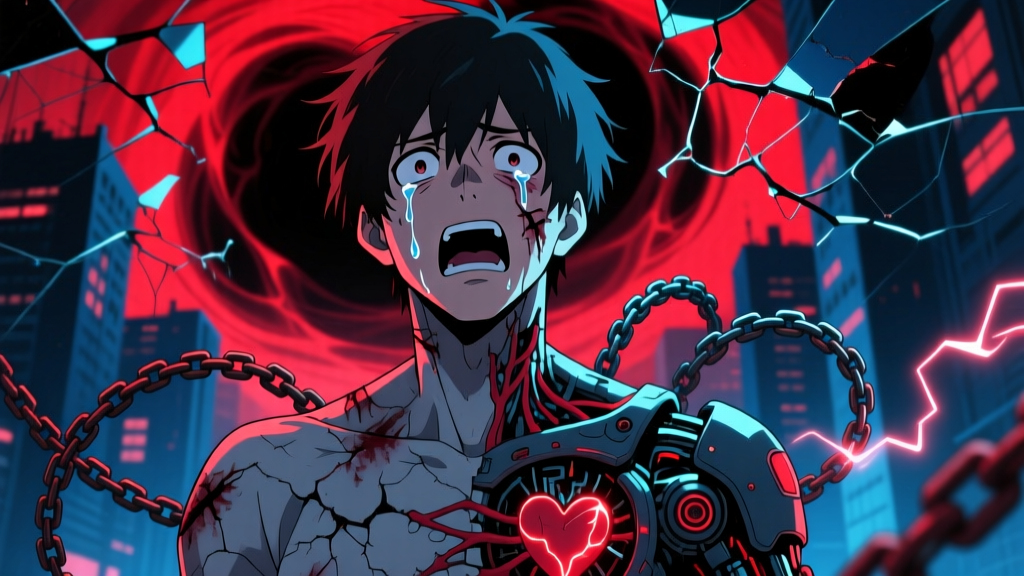
How Denji’s Heart-Stop Trauma Rewires His Moral Compass in Chainsaw Man Part 1
By liam-chen
Denji’s heart doesn’t stop because he’s weak—it stops because his nervous system has learned that love *is* cardiac arrest.
That’s not metaphor. Not poetic license. In Chainsaw Man Part 1, Denji’s three documented cardiac arrests—in Chapter 1 (after Makima’s “rescue”), Chapter 27 (post-Devil Hunt at the hospital), and Chapter 68 (after Makima’s betrayal in the elevator)—aren’t narrative stunts. They’re clinical anchors. Fujimoto draws them with surgical precision: chest heaving, pupils dilating, fingers clawing at sternum, then sudden stillness—no gasp, no dramatic last words, just silence punctuated by a flatline tone in MAPPA’s Episode 10 sound design. I remember watching that scene—the way the ambient city noise cuts out *before* the monitor beeps, leaving only Denji’s ragged inhale… then nothing for three full seconds. That pause isn’t suspense. It’s neurobiology rendered audible.
This isn’t shonen pain-as-catalyst. It’s trauma as somatic grammar.
Autonomic collapse, not heroic sacrifice
Let’s get concrete: Denji’s first arrest (Ch. 1, Viz Vol. 1) happens *after* Makima saves him—not during the fight with the Zombie Devil. He’s already safe. His body shuts down *in relief*. Fujimoto doesn’t show adrenaline dumping; he shows parasympathetic override—vagus nerve flooding the heart with acetylcholine, dropping HR to zero. That’s not exhaustion. That’s dorsal vagal shutdown: the nervous system’s last-ditch “freeze” response when fight-or-flight fails. Denji doesn’t black out from injury—he dissociates *from safety*, because safety has never been safe for him.
Compare Aki’s PTSD in Episode 10: hypervigilance, scanning doorways, flinching at sudden movement. His nervous system lives in sympathetic overdrive—always braced, always scanning. Denji’s? He oscillates between dorsal freeze (cardiac arrest) and manic, almost feral, sympathetic surges (e.g., Ch. 27’s hospital rampage, where he tears through walls *before* regaining consciousness). One is wired to anticipate threat; the other is wired to collapse *at the moment threat recedes*. That’s not two versions of trauma—it’s two divergent survival strategies forged in different kinds of neglect.
Aki grew up with structure, even if it was abusive. Denji grew up with *absence*: no consistent caregiver, no predictable meals, no medical care until Makima. His nervous system never learned how to downshift. So when safety arrives—even something as basic as being held—it triggers autonomic whiplash. His body doesn’t know how to metabolize care. It interprets tenderness as danger, because the only time he’s ever been touched gently was right before something broke.
Love as arrhythmia
Fujimoto makes this visceral in Vol. 3, p. 142 (Ch. 27): Denji wakes mid-arrest in the hospital, IV lines snaking from his arm, oxygen mask fogging with each shallow breath. The panel shows his hand gripping Makima’s wrist—not pulling her close, but *anchoring himself* against her. His knuckles are white. His eyes are unfocused. She smiles. He doesn’t blink. This isn’t affection. It’s neuroceptive calibration: his brain using her proximity as biofeedback to re-establish heart rhythm. Love, for Denji, isn’t warmth or trust—it’s physiological stabilization. It’s why he says, “I love you,” like a lifeline thrown across a chasm, not a confession. Because *literally*, without her, his heart stops.
And that’s why Makima’s betrayal in Ch. 68 hits with such brutal medical realism. The elevator scene isn’t just emotional devastation—it’s autonomic sabotage. She doesn’t just reject him. She *withholds the regulatory cue* his nervous system depends on. When she says, “I don’t need you anymore,” it’s not rejection—it’s withdrawal of co-regulation. His heart stops *because* she leaves. Not symbolically. Physiologically. Fujimoto draws the arrest in three tight panels: Denji’s pupils constricting (not dilating—this is *not* fear-based), his jaw locking, then the flatline. No blood. No scream. Just cessation. It’s the most terrifying kind of violence: the removal of the thing that kept you biologically alive.
MAPPA mirrors this in Episode 10’s sound design. The heartbeat fades *under* Makima’s dialogue—her voice stays crisp, dry, perfectly modulated, while Denji’s pulse drops out beneath it. You hear her words *clearer* as his biology fails. That’s not drama. That’s forensic storytelling.
Subverting the shonen contract
Shonen heroes endure pain to unlock power: Naruto’s Nine-Tails chakra, Luffy’s Gear transformations, Tanjiro’s Sun Breathing—all rooted in suffering-as-fuel. Denji’s pain doesn’t grant strength. It *unmakes* him. His Chainsaw transformation isn’t triggered by resolve or rage—it’s triggered by *fear of abandonment*. In Ch. 1, he doesn’t roar and transform when the Zombie Devil attacks. He transforms when Makima *leaves his side* to deal with the devil alone. His power activates at the precise moment his attachment figure withdraws—not when he faces danger, but when he faces *aloneness*.
That’s the quiet revolution of Chainsaw Man: Fujimoto treats trauma not as a hurdle to overcome, but as architecture. Denji’s moral compass isn’t “broken”—it’s *rewired*. His definition of “good” isn’t justice or duty. It’s proximity. His definition of “evil” isn’t cruelty or deception—it’s *distance*. When he kills the Control Devil later, it’s not vengeance. It’s an attempt to *reinstall* the regulatory presence he lost. He doesn’t want revenge. He wants his heart to beat again.
And that’s why his final act in Part 1—eating Makima’s remains—isn’t grotesque indulgence. It’s autonomic logic: if her presence regulated him, maybe her substance will too. It’s horrifying. It’s pathetic. It’s tragically coherent.
The hospital arc isn’t filler—it’s the thesis
Readers who only know MAPPA’s adaptation miss the critical expansion in the manga’s hospital arc (Vol. 4–5). Fujimoto spends pages on Denji’s post-arrest rehab: the tremors in his hands when he tries to hold chopsticks, the way he startles awake every 90 minutes—exactly the length of a non-REM sleep cycle, the body’s natural window for reconsolidating threat memory. There’s a panel on Vol. 4, p. 89 where Denji stares at his own reflection in a cafeteria tray, tracing the scar on his chest with one finger. His expression isn’t sad. It’s *confused*. Like he’s trying to map the geography of a wound he can’t name.
That’s the core of his moral disorientation. He knows *what* happened—Makima betrayed him—but he doesn’t know *how to feel about it*, because his nervous system never learned how to process betrayal as separate from annihilation. To Denji, abandonment *is* death. Not metaphorical. Cellular. Cardiac.
So when he later tells Aki, “I just want someone to hold me,” it’s not naivety. It’s diagnosis. It’s the clearest statement he can make in a language his body understands.
This works because Fujimoto refuses catharsis
Most trauma narratives build toward integration: the hero names the wound, processes it, emerges stronger. Denji doesn’t. His heart keeps stopping. His attachments stay volatile. His definitions of love and survival remain entangled—not because he’s “not healed yet,” but because healing, in his world, isn’t about returning to baseline. It’s about learning to live inside the dysregulation. To love *despite* the flatline. To want connection *knowing* it might kill him.
That’s why Chainsaw Man’s horror isn’t in the devils or the gore. It’s in the quiet moments after: Denji sitting on a curb, breathing too fast, waiting for his heart to catch up—not to danger, but to the unbearable lightness of being unheld.
His trauma isn’t a chapter in his story.
It’s the grammar of every sentence he speaks.
Every beat.
Every stop.
Every restart.
L
liam-chen
Contributing writer at SenpaiSite — Your Ultimate Anime & Manga Guide.