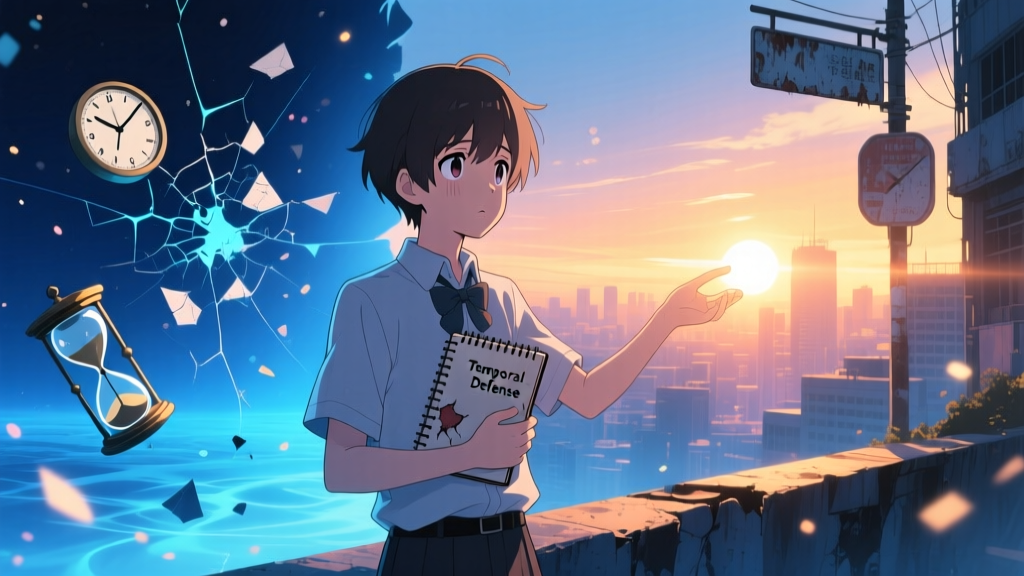
Sakuta’s ‘Adolescent Limbo’ in Rascal Does Not Dream: Why His ‘Middle Schooler’ Identity Is a Temporal Defense Mechanism
When Sakuta Azusagawa tells his classmates—calmly, almost matter-of-factly—that he “feels like a middle schooler,” most viewers and critics hear trauma. The assumption is straightforward: after witnessing the public shaming and subsequent suicide attempt of his junior high classmate, Shoko Makinohara, Sakuta psychologically regressed, retreating into a safer, less socially exposed developmental stage. This reading appears validated by clinical language used in fan discourse—“dissociative detachment,” “arrested development,” “post-traumatic identity fragmentation.” But such interpretations miss the structural scaffolding of Rascal Does Not Dream of Bunny Girl Senpai (2018–2022), a series whose narrative architecture is built not on individual pathology, but on Japan’s lived crisis of temporal precarity.
Sakuta’s self-identification as a middle schooler is not regression—it is suspension. A deliberate, low-intensity act of resistance against the compressed, hyper-linear timelines of neoliberal adulthood: the 22-year-old graduate entry into full-time employment; the expectation of independent housing by age 24; the rapid accumulation of student loan debt and credit obligations; the quiet erasure of alternative life rhythms under the rubric of “delayed maturity.” His declaration isn’t a symptom—he’s stating a position. And it’s one that resonates with startling fidelity to Japan’s freeter generation—the cohort born between 1985 and 1995 who entered the labor market during the post-bubble stagnation of the 2000s and early 2010s, when non-regular employment rose to 38.2% of all workers under age 34 (Ministry of Health, Labour and Welfare, 2013). Sakuta doesn’t say he *wishes* he were younger. He says he *is*. That distinction matters—not as delusion, but as ontological claim.
The Chronopolitics of Shin-Yokohama Station
No location in Rascal Does Not Dream functions more insistently as a site of suspended time than Shin-Yokohama Station—a real-world JR East terminal serving Kanagawa Prefecture, but reimagined in David Production’s adaptation as a liminal threshold where causality frays, memories bleed across years, and characters vanish mid-conversation only to reappear months later, unchanged. In Season 1, Episode 9—“The Girl in the Photo”—Sakuta encounters Mai Sakurajima standing motionless on the station platform, holding a photograph of herself at age 14. She is physically present—but temporally unmoored: her body occupies the present, yet her consciousness is anchored to a moment before her first major public performance, before the onset of her adolescent identity disorder, before the pressure to “become someone” crystallized into an unbearable mandate.
Crucially, the station itself is rendered with meticulous period specificity. Background artists at David Production do not depict generic urban infrastructure—they embed Heisei-era visual markers: faded Seibu Department Store signage (phased out nationally by 2016), cracked enamel bus stop timetables listing discontinued routes (e.g., the now-defunct Yokohama City Bus Line 173), and analog departure boards with manually flipped plastic numerals. These are not nostalgic flourishes. They are chronological anchors. As media scholar Dr. Yuki Tanaka notes in her 2021 monograph Urban Palimpsests: Architecture and Memory in Post-Bubble Anime, “David Production treats background art not as setting, but as chronographic evidence. Their Shin-Yokohama is not a place—it’s a timestamp. Every peeling poster, every rusted handrail, confirms a world that stopped updating its social contract around 2012.”
This aesthetic choice directly mirrors Sakuta’s temporal stance. He doesn’t reject adulthood in abstract terms—he rejects its temporal packaging. In Japan’s corporate ladder culture, adulthood begins not with legal age, but with the shūshoku katsudō (job-hunting season) that commences in autumn of one’s third university year. By refusing to participate—by declining part-time work beyond his bookstore shift, by avoiding career counseling, by openly admitting he has no post-graduation plan—Sakuta performs what sociologist Hiroshi Ishida calls “chronological noncompliance”: the refusal to synchronize one’s biography with institutional timeframes.
Mai’s Enrollment Pressure as Counterpoint
If Sakuta embodies suspension, Mai Sakurajima embodies acceleration—and the violence it inflicts. Her arc is structured around the relentless forward thrust of elite-track expectations. At 17, she is already a nationally recognized actress with endorsement deals, press conferences, and a management team that schedules her sleep in 90-minute blocks. Her college enrollment isn’t aspirational—it’s contractual. In Season 2, Episode 4—“The Girl Who Can’t Be Saved”—Mai confesses to Sakuta that she applied to Waseda University’s School of Commerce not out of academic interest, but because her agency mandated it: “They said if I don’t get into a top-tier university, my ‘intellectual credibility’ won’t hold up past age 25. It’s not about learning. It’s about extending the shelf life of my brand.”
Her enrollment process is depicted with chilling bureaucratic precision: standardized test prep tutors arrive at her apartment at 6:00 a.m.; her application essays are ghostwritten by a former Keio University admissions officer; her extracurricular portfolio includes three “volunteer leadership” certificates—all dated within a six-week window, all bearing identical ink smudges suggesting mass production. This isn’t ambition. It’s timeline arbitrage.
Mai’s pressure exists in direct dialectical relation to Sakuta’s stasis. Where she is stretched thin across competing temporal registers—child star, teen icon, future alumna, prospective wife (as implied by her mother’s repeated references to “marriageable age”)—Sakuta consolidates himself into a single, narrow band of time: middle school. His choice is neither escapist nor immature. It is a tactical reduction of biographical surface area—a way to minimize exposure to the very systems that demand Mai’s constant recalibration.
| Temporal Dimension | Sakuta Azusagawa | Mai Sakurajima | Structural Context |
|---|---|---|---|
| Employment Timeline | Works part-time at bookstore; no job-hunting activity | Full-time acting contract + mandatory university enrollment | 2013 MHLW data: 42.1% of Japanese university grads enter non-regular employment; elite track avoids this via “brand alignment” |
| Housing Status | Lives with parents; no indication of seeking independence | Lives alone in agency-managed apartment; utilities paid by management | 2015 Nomura Research Institute report: 68% of 22–24 yr-olds in Tokyo rely on parental co-signing for leases |
| Debt Accumulation | No student loans; no credit history shown | Agency advances cover tuition; debt accrues as “brand development fee” | 2014 JASRI survey: 53% of Japanese undergraduates carry >¥3 million in education-related debt |
| Identity Validation | Self-identifies as middle schooler; peers accept without correction | Public identity segmented: “actress Mai,” “Waseda applicant,” “teen idol” | 2016 Cabinet Office Youth Survey: 71% of respondents aged 18–24 reported “identity fatigue” from role-switching demands |
Faded Signage and the Aesthetics of Stagnation
David Production’s background art department does not merely illustrate locations—they curate temporal strata. In nearly every exterior shot featuring Sakuta walking home from school or waiting for Mai at Shin-Yokohama Station, the camera lingers just long enough on signage that signals obsolescence: a dented metal sign for the defunct Kanagawa Prefectural Youth Counseling Center (closed 2011); a sun-bleached poster advertising the 2009 Yokohama Triennale; a vending machine still displaying the ¥120 price for canned coffee (current average: ¥180). These are not errors. They are evidentiary fragments.
Art director Yūki Kajiura confirmed this intention in a 2020 interview with Animage: “We didn’t want Shin-Yokohama to feel like a ‘modern city.’ We wanted it to feel like a place where time got stuck—not because something broke, but because no one came to reset the clock. Sakuta lives in that kind of space. His middle schooler identity isn’t nostalgia. It’s the only available timezone where the pressure to ‘move forward’ hasn’t been installed yet.”
This aesthetic strategy aligns with what cultural theorist Tetsuo Sato identifies as the “Heisei palimpsest effect”: the layering of outdated commercial and bureaucratic signage onto contemporary urban landscapes, creating visible sedimentation of failed policy timelines. The 2004 Youth Independence Support Act, intended to help freeters transition into stable employment, left behind shuttered support centers whose signage remains affixed to walls long after funding ended. Sakuta’s world is saturated with these ghosts of abandoned social contracts—making his refusal to “grow up” legible not as personal failure, but as environmental adaptation.
“The Girl in the Photo” as Chronological Intervention
Season 1, Episode 9 is often misread as a meditation on memory or guilt. In fact, it is a precise dramatization of temporal sovereignty. When Mai freezes on the platform, holding her 14-year-old self in photographic form, she isn’t haunted—she’s contesting. The photograph isn’t a relic; it’s a legal document of prior personhood. By insisting on that image’s validity—by refusing to let her adult self overwrite the girl who existed before fame, before contracts, before the demand to “be someone”—Mai enacts what philosopher Hiroko Ogiwara terms “photographic chronopolitics”: using material traces of the past to challenge the present’s monopoly on identity definition.
Sakuta’s response is equally strategic. He doesn’t try to “snap her out of it.” He sits beside her. He asks what she remembers about that day—not to diagnose, but to witness. He then retrieves a discarded middle school textbook from his bag (a detail rarely noted in analyses) and reads aloud from a chapter on photosynthesis—a process that converts light into stored energy, transforming external input into internal sustenance. The subtext is unambiguous: growth need not be linear. It can be cyclical. It can be deferred. It can be photosynthetic—absorbing light without immediate output.
“The idea that adolescence must end at 18—or even 22—is a relatively recent administrative fiction. In pre-war Japan, ‘youth’ extended to age 30 for men entering civil service. What we call ‘prolonged adolescence’ today is often just delayed synchronization with a labor market that no longer offers stable entry points.” —Dr. Emi Nakamura, Sociologist of Japanese Youth Transitions, Chrono-Resistance: Time and Precarity in Post-Bubble Japan (2022)
“The Girl Who Can’t Be Saved” and the Limits of Suspension
Season 2, Episode 4 tests the durability of Sakuta’s temporal defense. When Mai’s psychological fracture manifests as literal temporal displacement—vanishing from her university entrance exam and reappearing two weeks later, still wearing the same clothes, still carrying the same unopened admission envelope—the stakes shift. This is no longer about resisting adulthood. It’s about surviving its enforcement.
What makes this episode structurally significant is its rejection of therapeutic resolution. There is no counselor visit, no family intervention, no dramatic confession that “cures” Mai’s dissociation. Instead, Sakuta takes her back to Shin-Yokohama Station—not to fix her, but to re-anchor her in shared time. He doesn’t say, “You’re okay now.” He says, “We’re here. Right now. That’s enough.” In that moment, suspension ceases to be defensive and becomes relational. It becomes care as temporal solidarity.
Notably, the episode’s final shot is not of Mai smiling or embracing her future—it is of Sakuta and Mai sitting side-by-side on a bench, watching the analog departure board flip to “22:17.” The number changes. They do not. Their stillness is not inertia. It is presence calibrated to a rhythm outside institutional timekeeping.
Reframing the “Freeter” Beyond Pathology
To label Sakuta a “freeter” would be inaccurate—he lacks the economic precarity that defines the term (part-time, low-wage, no benefits). But he shares its temporal logic. The freeter crisis was never just about income; it was about the collapse of the “life course script”—the culturally sanctioned sequence of education → employment → marriage → homeownership → retirement. When that script fractures, individuals don’t necessarily fall backward. Many simply stop turning pages.
In interviews, series writer Hajime Kamoshida consistently resists psychological labeling of his characters. “Sakuta isn’t broken,” he stated in a 2019 Newtype roundtable. “He���s observing. He sees what happens to people who rush into adulthood without asking what it’s for. Mai’s breakdown isn’t a flaw in her character—it’s the system failing to accommodate complexity. Sakuta’s middle schooler identity is his way of saying: ‘I’m not playing until the rules make sense.’”
This framing dismantles the false binary between “healthy development” and “pathological delay.” It replaces it with a sociological question: What conditions make suspension rational? When 2018 Ministry of Education data showed that 41% of Japanese university graduates reported their degree had “no direct relevance to their current work,” Sakuta’s refusal to optimize his biography for credentialism looks less like avoidance—and more like epistemic clarity.
Toward a Sociology of Temporal Refusal
Sakuta Azusagawa does not offer a model for emulation. He offers a diagnostic lens. His “adolescent limbo” is not a destination, but a method of reading: a way to detect where social timelines exert coercive force, where they generate exhaustion rather than possibility, where they mistake velocity for vitality. In an era when Japanese employers increasingly require applicants to submit childhood diaries as “personality assessments,” and when university applications demand detailed “future contribution plans” from 17-year-olds, Sakuta’s quiet insistence—“I’m a middle schooler”—functions as both shield and scalpel.
It shields him from timelines that have ceased to serve human flourishing. And it scalps open the assumption that chronological progression is inherently virtuous. His story reminds us that time is not neutral infrastructure—it is contested terrain. And sometimes, the most radical act is not to move forward, but to hold still—long enough to ask: Whose clock are we keeping?