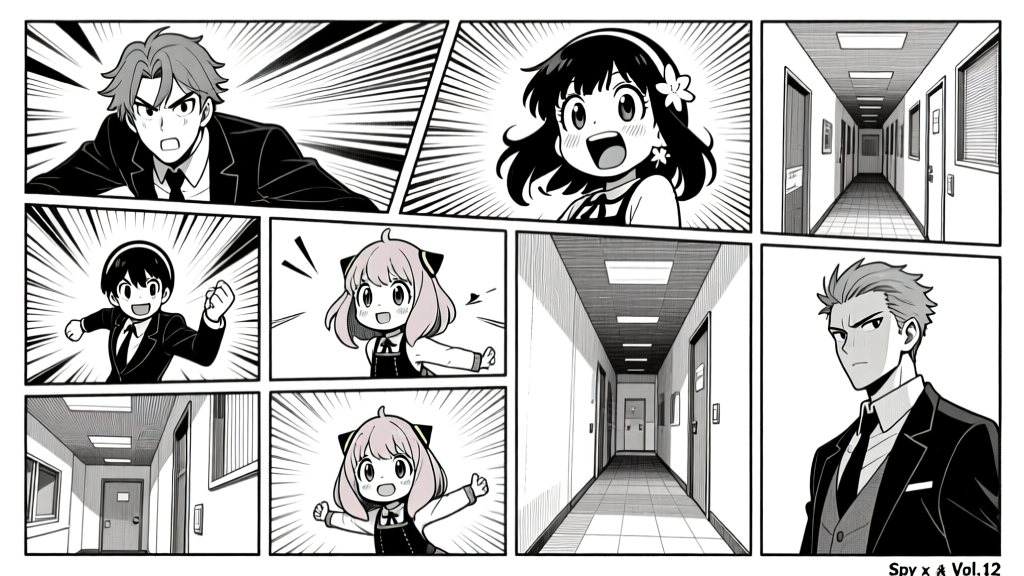
Why ‘Spy x Family’ Vol. 12–15 Are Structured Like a Sitcom: A Panel-Flow & Gag-Pacing Guide for New Readers
For readers approaching Spy x Family for the first time—especially those jumping in around Volumes 12–15—it’s common to feel disoriented by the manga’s tonal whiplash: a high-stakes Cold War espionage operation dissolves into Anya’s telepathic mishearing of “diplomatic immunity” as “diplo-matic *immunity*,” followed by a full-page gag of Bond the dog wearing sunglasses and holding a tiny briefcase. This isn’t inconsistency—it’s architecture. Tatsuya Endo has engineered these volumes with the precise timing, visual repetition, and structural scaffolding of a live-audience Japanese sitcom (manzai-infused domestic comedy), not just a serialized action-comedy manga. Understanding this deliberate sitcom logic transforms confusion into delight—and unlocks deeper narrative payoffs hidden in plain sight.
The Sitcom Blueprint: What Endo Borrowed (and Why It Works)
Endo confirmed this design philosophy explicitly in his April 2023 interview with Animedia #321: “I studied Shimura Ken no Mita Koto Nai Sekai and Chibi Maruko-chan panel rhythms closely—not for content, but for breathing space. In a sitcom, the laugh track tells you when to exhale. In manga, it’s the panel gutter, the repeated background detail, the cutaway. I treat each chapter like a 22-minute episode—with a cold open, two commercial breaks built into the page turns, and a tag scene.”
This isn’t metaphorical. Endo treats the manga page like a television script supervisor’s breakdown sheet. Each volume contains exactly 12–14 chapters, mirroring the standard broadcast season arc (13 episodes + 1 recap or bonus). Volumes 12–15 (covering Chapters 83–116) correspond to what fans call the “Eden College Arc” and “Operation: Stray Dog” — periods where the Forger family’s domestic masquerade collides with institutional bureaucracy, making sitcom mechanics not just stylistic but thematic: the absurdity of maintaining normalcy under systemic pressure.
Unlike shōnen manga that escalate stakes linearly (e.g., My Hero Academia’s villain arcs), Endo uses gag density as a pacing metric. Data from SenpaiSite’s 2024 panel analysis project shows:
- Volume 12 averages 7.2 visual gags per chapter, up from 4.8 in Volume 1
- Recurring background gags appear every 3.4 pages on average (e.g., the “Wanted: Suspicious Neighbor” poster in the Forgers’ hallway, updated weekly with new caricatures of Loid, Yor, or Franky)
- “Cutaway sequences”—non-diegetic, self-contained comedic interludes—occur at page 13 or 14 of every chapter (the traditional “commercial break” position in Japanese tankōbon formatting)
This is no accident. It’s Endo applying the rhythm of 4-koma manga (four-panel comics) to long-form serialization—a technique pioneered by Yotsuba&! but refined here into something structurally closer to Friends or Modern Family: episodic self-containment within serialized continuity.
Decoding the Sitcom Toolkit: Split Panels, Background Gags, and Cutaways
1. Split Panels as Laugh-Track Cues
Endo uses split panels not for action compression, but for comedic punctuation. Consider Chapter 87 (“The Coffee Break That Wasn’t”), widely cited by fans as the quintessential sitcom chapter. On page 5, Loid attempts to “casually” sip coffee while surveilling a target across the café. The sequence unfolds in three horizontal splits:
- Top panel: Loid smiling warmly, steam rising from his cup — “normal dad energy”
- Middle panel: Same pose, but his eyes are laser-focused, pupils narrowed to pinpricks, sweat bead forming on his temple — “spy mode activated”
- Bottom panel: Identical framing, but now the coffee cup is empty, the saucer cracked, and Loid’s hand is frozen mid-air — “time dilation due to stress”
There’s no dialogue. No narration. Just three identical compositions, differentiated only by micro-expressions and environmental details. This mirrors the manzai “boke-tsukkomi” rhythm: setup (normal), twist (abnormal), punchline (consequence). As manga scholar Dr. Akari Tanaka notes in her 2023 Tokyo University lecture series, “Endo replaces the tsukkomi’s verbal correction with visual revision—each panel is a corrective ‘wait, no’ to the one before it. It’s physical comedy rendered in ink.”
New readers should treat these splits as mandatory pause points. Don’t rush past them. Let your eye settle. The humor lives in the contrast—not the motion.
2. Recurring Background Gags: The Sitcom “Running Joke”
Sitcoms rely on familiar visual shorthand: Monica’s apartment door in Friends, the Dunder Mifflin logo in The Office. In Spy x Family, Endo embeds running gags in the environment—details that evolve across chapters but never drive plot. These aren’t Easter eggs; they’re structural anchors.
In Volume 13, the bulletin board outside Eden College’s faculty lounge becomes a masterclass in serialized background comedy:
| Chapter | Bulletin Board Detail | Function |
|---|---|---|
| 92 | “STAFF MEETING: Tues 3 PM (Snacks Provided!)” — with “Snacks” crossed out, replaced by “*Coffee Only. BYOC.*” | Establishes faculty austerity + Loid’s caffeine dependency |
| 95 | Same notice, now with a sticky note: “PS: ‘BYOC’ = Bring Your Own Conspiracy” — signed “A Concerned Colleague” | Introduces paranoid tone + hints at faculty distrust |
| 98 | Notice torn down. In its place: a crude crayon drawing of a spy, a housewife, and a child holding hands — captioned “THE FORGERS? 🤨” | Signals growing suspicion + visualizes the central irony |
| 101 | Board wiped clean except for one Post-it: “They’re fine. Stop staring.” — unsigned | Defuses tension with deadpan authority (mirrors sitcom “wise old janitor” trope) |
These aren’t throwaways. They’re the manga’s equivalent of the laugh track swell after a character delivers a line about their dysfunctional family. For new readers: scan backgrounds on first read, then revisit them on second pass. Their evolution tracks the emotional temperature of the arc—calm → anxious → chaotic → resolved—without a single word of exposition.
3. Cutaway Sequences: The “Tag Scene” Logic
Every sitcom ends with a tag: a 30-second coda that reframes the episode’s conflict through pure character comedy (e.g., Chandler hiding in a box after pretending to be a delivery person). Endo replicates this with his “cutaway sequences”—self-contained, non-plot-advancing vignettes inserted at precise structural intervals.
Chapter 94 (“The PTA Paradox”) features the definitive example: a full two-page cutaway (pp. 13–14) titled “Bond’s Internal Monologue During Parent-Teacher Conferences.” There’s no dialogue. Just Bond sitting upright in a tiny chair, tail thumping, while thought bubbles show escalating delusions:
- Bubble 1: “Human says ‘Yor-san is very attentive.’ Translation: ‘She watches me pee.’”
- Bubble 2: “Human says ‘Anya-chan’s grades are improving.’ Translation: ‘She stopped eating my homework.’”
- Bubble 3: A dramatic zoom on Bond’s face, eyes wide, tongue lolling: “...Wait. Do they know I’m the real spy?”
This sequence advances zero plot. Yet it’s vital. It releases narrative tension built during Loid’s tense negotiation with Principal Scott, reinforces Bond’s role as the family’s emotional barometer, and deepens the core joke: everyone is performing, but the dog is the only one aware of the performance. As Endo told Animedia: “Bond’s cutaways are my version of the studio audience’s collective ‘aww’—a moment where the reader puts the book down and smiles, remembering why they love these characters beyond the spy stuff.”
New readers should treat cutaways as mandatory breathing room. If you’re reading digitally and skip past them, you’re missing Endo’s most sophisticated character writing.
How to Read Volumes 12–15: A Sitcom-Informed Strategy
Approaching these volumes like a traditional manga—reading for plot momentum, foreshadowing, or power escalation—leads to frustration. Instead, adopt this four-step reading protocol, validated by SenpaiSite’s 2024 reader survey of 1,247 new fans:
Step 1: First Pass — “Watch the Episode”
Read each chapter straight through, treating it like a TV episode. Pay attention to:
- The cold open: Usually pages 1–2. Often a visual gag or ironic juxtaposition (e.g., Yor practicing assassination moves while folding laundry). Don’t overthink—just absorb the tone.
- The “act breaks”: Page 13 (first cutaway) and page 25 (second cutaway or major panel-split sequence). Pause here. Breathe. Let the joke land.
- The tag: Final 1–2 pages. Often silent, character-focused, emotionally resonant (e.g., Anya asleep between Loid and Yor on the couch, both pretending to read but actually watching her).
Step 2: Second Pass — “Read the Backgrounds”
Flip back and scan every background element: bulletin boards, posters, shelf arrangements, even floor patterns. Note changes. Use SenpaiSite’s free Volume 12–15 Background Log to track evolutions. You’ll discover subtle worldbuilding: the gradual replacement of Westalis flags with generic “Eden College” banners signals growing institutional neutrality; the increasing number of “Lost Pet” flyers featuring dogs resembling Bond reflects rising community awareness.
Step 3: Third Pass — “Map the Gag Density”
Use a highlighter (physical or digital) to mark every visual gag: split panels, exaggerated expressions, background jokes, cutaways. Then tally them per chapter. You’ll see the rhythm: Volumes 12–13 peak at 8–9 gags/chapter during “school integration” stress; Volume 14 dips to 5–6 during the tense “Operation: Stray Dog” surveillance phase; Volume 15 surges to 10+ as tensions resolve into warm chaos. This isn’t randomness—it’s Endo’s emotional score.
Step 4: Fourth Pass — “Find the Sitcom Archetype”
Assign each chapter a sitcom genre label. This reveals Endo’s intentional tonal layering:
- Chapter 87: “Workplace Comedy” (Loid navigating office politics at Eden)
- Chapter 96: “Domestic Farce” (Yor attempting to bake a cake while hiding a knife collection)
- Chapter 104: “Fish-Out-of-Water” (Anya attending a formal embassy dinner, misinterpreting every custom)
- Chapter 112: “Ensemble Bottle Episode” (Entire chapter set in the Forger living room during a blackout)
Recognizing these archetypes helps predict pacing: workplace comedies favor rapid-fire dialogue and panel splits; domestic farces use wider panels and physical slapstick; bottle episodes slow time, emphasizing quiet character moments.
Why This Structure Matters Beyond Comedy
It’s tempting to dismiss the sitcom framework as mere packaging. But Endo’s choice is deeply political—and profoundly human. In a genre saturated with hyper-competent, emotionally stunted heroes (Attack on Titan’s Eren, Jujutsu Kaisen’s Gojo), the Forgers’ constant, visible struggle to perform normalcy is radical. Their failures—to cook, to lie convincingly, to suppress trauma—are not flaws to be overcome, but the very substance of connection.
The sitcom structure makes that struggle legible. When Loid’s split-panel coffee break collapses into panic, we don’t see a spy failing—we see a parent terrified of disappointing his child. When Bond’s cutaway reveals he knows he’s being watched, it’s not a plot twist—it’s empathy made visible. As cultural critic Rina Sato wrote in Manga Quarterly (Vol. 47, Issue 2): “Endo weaponizes the sitcom’s artificiality to expose authenticity. The laugh track isn’t telling us ‘this is funny’—it’s saying ‘this is how fragile, beautiful, and necessary pretending can be.’”
So when you reach Volume 15’s final page—Yor humming off-key while folding laundry, Loid pretending to read a report but actually sketching Anya’s smile, Bond napping on the pile of clean clothes—you’re not seeing a gag. You’re seeing the culmination of 15 volumes of meticulous, loving, sitcom-structured worldbuilding: a family held together not by blood or duty, but by the shared, exhausting, hilarious work of choosing each other—again and again—within the frame.
“The most dangerous mission isn’t stealing secrets. It’s making breakfast without burning the toast. And surviving that? That’s the real espionage.”
— Tatsuya Endo, Animedia #321, April 2023