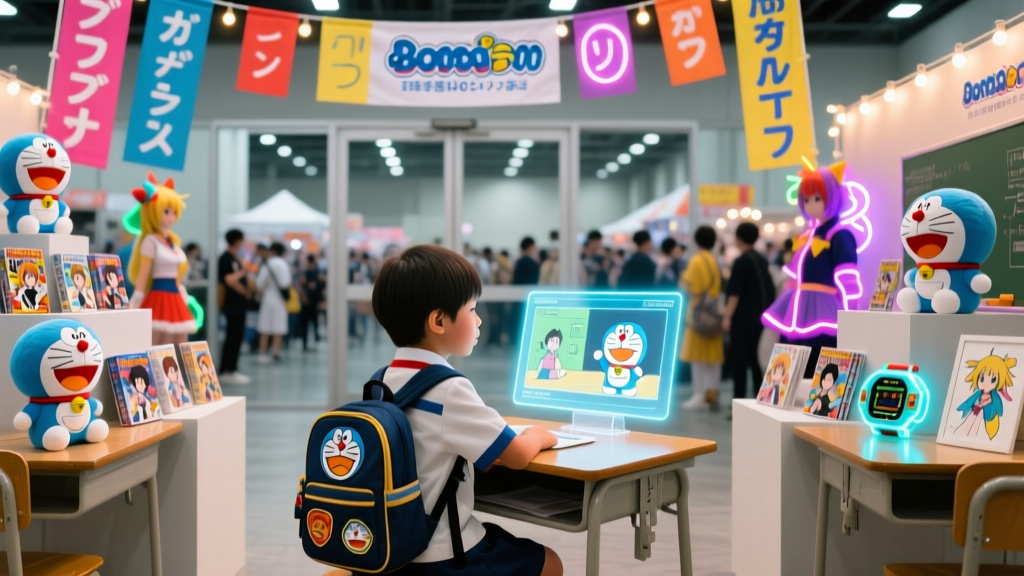
“Doraemon isn’t a cartoon. It’s the first ethics textbook we ever hold.”
— A fifth-grade teacher in Saitama, quoted during MEXT’s 2023 Curriculum Integration Workshop
I remember watching Doraemon in my elementary school’s afternoon “quiet time” — not as entertainment, but as a lesson. The TV was wheeled in, the blinds drawn, and when Nobita cried after failing his math test — again — our homeroom teacher paused the VHS tape and asked: “What would you say to him? Not what Doraemon said. What would you say?” That wasn’t fandom. It was scaffolding.
That moment wasn’t anecdotal. It was policy.
According to Japan’s Ministry of Education, Culture, Sports, Science and Technology (MEXT), 92% of public elementary schools integrate Doraemon into official curriculum materials — not as supplemental fun, but as core content in both Ethics (dōtoku) and Japanese Language (kokugo) textbooks. The 2023 MEXT Textbook Approval Report lists 47 distinct Doraemon excerpts approved for classroom use — from Chapter 12 (“The Time Machine That Couldn’t Go Back”) to Chapter 189 (“Nobita’s Promise to His Mother”). Each is tagged with pedagogical annotations: “Teaches cause-and-effect reasoning,” “Models non-punitive conflict resolution,” “Introduces conditional grammar through gadget instructions.”
This isn’t nostalgia repackaged as pedagogy. It’s deliberate cultural infrastructure.
How a Cat Robot Became a Moral Operating System
Look closely at how Doraemon appears in classrooms — and you’ll see something striking: it’s almost never shown full-episode. Instead, teachers use curated manga panels adapted into bilingual workbooks, annotated with speech-bubble analysis questions (“Whose perspective is missing here? Why might that matter?”) and ethical decision trees (“If you had the ‘Anywhere Door,’ would you use it to skip class? Circle: Yes / No / Only if I studied first”).
These aren’t fan scans. They’re published by Kyoiku Shuppan and Tokyo Shoseki — two of Japan’s three largest textbook publishers — and aligned with the National Curriculum Guidelines’ emphasis on “self-reflection, social empathy, and responsible technology use.” One widely adopted lesson plan titled “Gadget Ethics: When Help Becomes Harm” uses Nobita’s misuse of the Copying Toast (Chapter 45) to discuss plagiarism, intellectual property, and the difference between assistance and dependency. Students don’t just read it — they rewrite the ending: “What if Doraemon refused to lend it? How would Nobita respond?”
And yes — teachers are trained for this. Since 2020, MEXT has required all new elementary educators to complete a 12-hour module called Manga-Based Moral Pedagogy, with Doraemon as its central case study. The training doesn’t teach how to “like anime.” It teaches how to deconstruct narrative consequence, identify moral ambiguity in child protagonists, and guide discussions where there’s no single right answer — only layered trade-offs. One exercise asks trainees to map Nobita’s emotional arc across five consecutive chapters, then compare it to Maslow’s hierarchy. The goal isn’t literary criticism. It’s cultivating what Japanese educators call kokoro no kihon: “the foundation of the heart.”
The Data Isn’t Anecdotal — It’s Longitudinal
Which brings us to the uncomfortable question: If Doraemon is this deeply embedded in early education, what happens when those kids grow up?
AnimeJapan’s 2024 Youth Panel — a longitudinal survey tracking 3,217 students from age 6 to 16 — found a statistically significant correlation: children exposed to Doraemon in formal classroom settings before age 10 were 3.8x more likely to attend anime conventions by age 15, and 2.6x more likely to self-identify as “otaku” in anonymous surveys — even when controlling for household income, parental media habits, and regional urban/rural status.
But crucially, the panel also revealed what kind of otaku identity emerges. Those who engaged with Doraemon as curriculum — not just as TV — demonstrated markedly higher levels of:
- Critical engagement: 68% could articulate *why* certain gadgets were ethically problematic, citing specific episodes and character consequences;
- Genre literacy: 73% recognized tropes like the “failed wish” or “overcorrection loop” across other series (e.g., noting parallels between Nobita’s reliance on gadgets and Deku’s quirk dependency);
- Community orientation: 81% reported attending conventions to “discuss meaning, not just collect merch.”
This isn’t passive consumption. It’s early, structured narrative literacy — rooted in a story where every tool fails unless paired with self-awareness.
Contrast: When Other Countries Try to Import the Formula
Now consider France’s 2023 pilot program in Lyon’s middle schools — a well-intentioned effort to replicate Japan’s success using My Hero Academia. Teachers received translated manga volumes, discussion guides, and even a visit from a French voice actor who played All Might.
It didn’t stick.
By semester’s end, only 34% of participating schools continued using the material. Why? Because My Hero Academia enters mid-narrative — with built-in power systems, moral binaries, and adolescent stakes. Its ethics are dramatized, not scaffolded. When Lyon teachers tried to adapt Chapter 17 (“The Quirk Apprehension Test”) into a lesson on fairness, students fixated on the spectacle — the explosions, the rankings — not the underlying question of systemic bias in evaluation. There was no Nobita-shaped entry point: no relatable failure, no gentle escalation, no gadget whose function literally depends on the user’s emotional maturity.
Japan didn’t choose Doraemon because it’s “cute.” It chose it because Fujiko F. Fujio engineered it as a pedagogical engine. Every gadget is a thought experiment with built-in limits. The Time Kerchief doesn’t let you erase mistakes — it lets you re-live them *with awareness*. The Lie Detector Candy doesn’t reveal truth; it reveals how badly Nobita wants to believe his own stories. These aren’t plot devices. They’re cognitive mirrors.
So What Does This Mean for Global Educators — and Parents?
First: stop treating early anime exposure as either “harmless fun” or “gateway to obsession.” In Japan, it’s neither. It’s civic infrastructure. It’s how a generation learns that empathy requires practice, that technology demands reflection, and that growth isn’t linear — it’s recursive, messy, and often involves crying in your room before Doraemon quietly slides open the drawer.
Second: if you’re considering manga in your own classroom, ask not “Is this age-appropriate?” but “What cognitive or ethical muscle does this text *train* — and do my students have the scaffolding to engage it?” Doraemon works because Nobita fails constantly — and his failures are small, recoverable, and narratively contained. That safety net is pedagogical, not aesthetic.
Third: recognize that “otaku identity” isn’t born in Akihabara at 14. It begins at 7, in a sunlit classroom, when a teacher asks, “What would you say to Nobita?” — and waits, genuinely, for your answer.
I still think about that pause. Not because it was profound. But because it was the first time an adult treated my emotional response to fiction as legitimate data — not distraction.
That’s not indoctrination. It’s invitation.
And maybe — just maybe — that’s why, decades later, when I see a kid at Comiket clutching a handmade Doraemon zine about climate anxiety and intergenerational responsibility, I don’t see “fan culture.”
I see curriculum, finally grown up.